Using Colourful Semantics to Scaffold Sentence Development
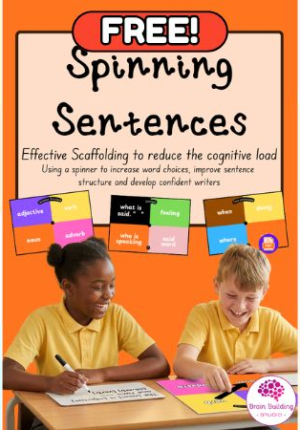
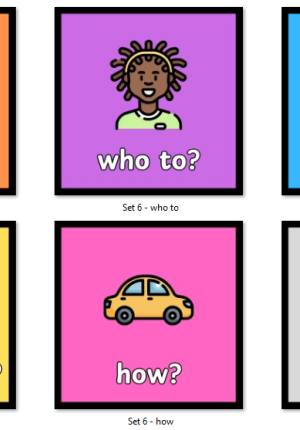
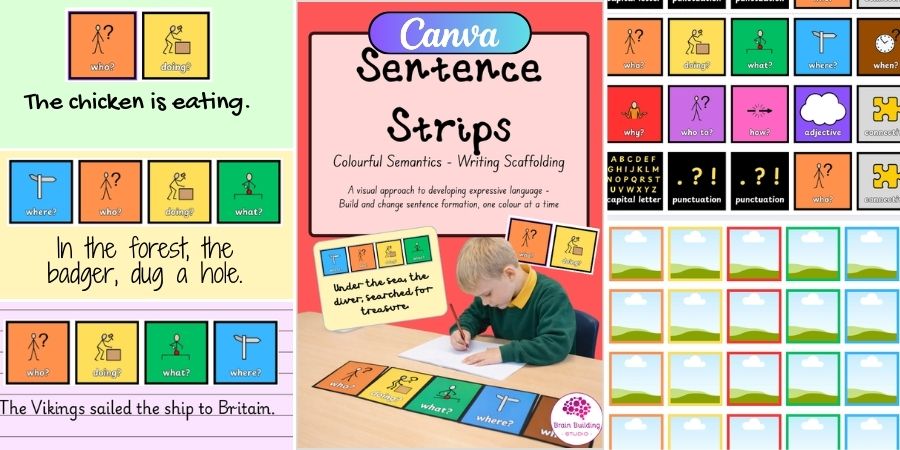
Colourful Semantics is a structured, visual approach to developing expressive language. It uses consistent colour coding to represent different parts of a sentence (e.g., who, doing, what, where, when) to help children understand how sentences are organised and how meaning is constructed.
The approach works by explicitly teaching each sentence element in isolation before gradually combining them. This reduces cognitive load and provides a clear visual scaffold for children who struggle with language processing, working memory, or sentence organisation.
Progression and Increasing Complexity
The cards are introduced in a carefully sequenced hierarchy:
-
Two-part sentence: Who + Doing
-
Establishes the basic subject–verb structure.
-
Supports children to understand that someone is performing an action.
-
Builds foundational sentence awareness.
-
-
Three-part sentence: Who + Doing + What
-
Introduces objects and expands meaning.
-
Encourages more precise vocabulary.
-
Moves from simple action statements to transitive sentences.
-
-
Four-part sentence: Who + Doing + What + Where
-
Adds contextual information.
-
Supports children in extending utterances beyond core meaning.
-
Develops narrative and descriptive skills.
-
-
Five-part sentence: Who + Doing + What + Where + When
-
Introduces time concepts.
-
Encourages sequencing and more advanced narrative structure.
-
Promotes use of adverbial phrases and temporal language.
-
How the Scaffolding Supports Sentence Building
The colour coding provides a consistent visual framework that:
-
Makes abstract grammar concepts concrete.
-
Supports working memory by visually holding sentence elements in place.
-
Encourages children to notice missing elements (“We have who and doing — what is missing?”).
-
Promotes independent sentence expansion.
-
Reduces language anxiety by offering a predictable structure.
As children progress, the scaffold can be gradually reduced:
-
Removing visual prompts.
-
Asking children to generate their own sentence elements.
-
Encouraging varied vocabulary within each colour category.
-
Moving from spoken to written sentence construction.
Over time, this structured layering supports children to move from simple two-word utterances to grammatically complete, detailed sentences, strengthening both expressive language and early literacy skills.