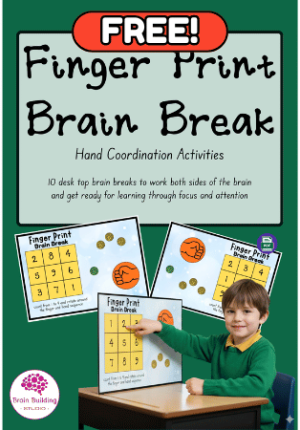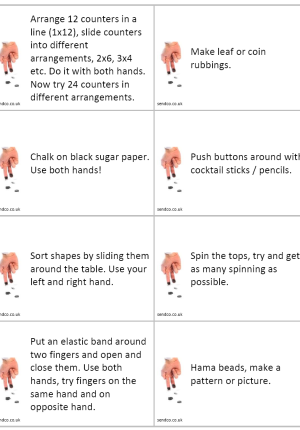
Finger Print Brain Breaks Download Here
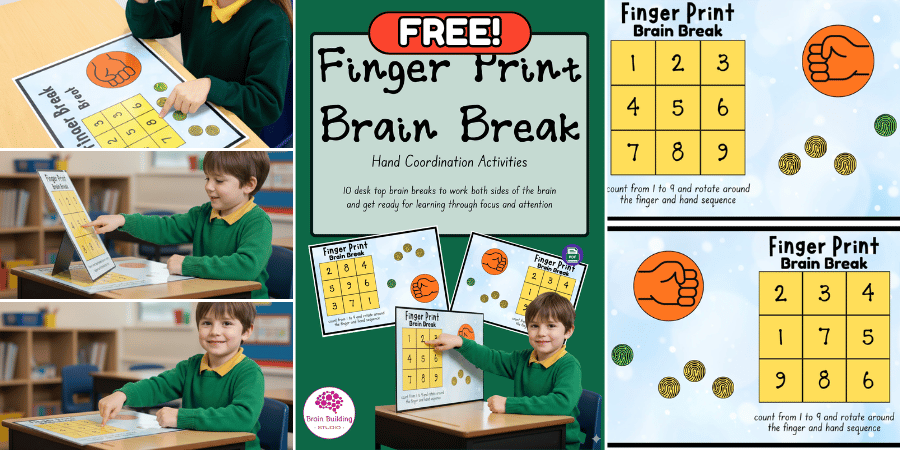
Midline Coordination Activities
What is the midline and bilateral coordination?
The midline is an imaginary line down the centre of the body. Crossing it means a hand, foot or eye moves into the opposite side of space.
Bilateral coordination is using both sides of the body together. It includes:
- Symmetrical movements (clapping)
- Alternating movements (crawling)
- Dominant/supporting roles (cutting with scissors)
Why does this matter?
Crossing the midline strengthens communication between the brain’s hemispheres, supporting movement, learning and organisation.
Strong midline and bilateral skills help with:
- Eye tracking for reading
- Handwriting fluency
- Coordination in PE and play
- Planning and sequencing
- Everyday independence
Children who struggle may tire quickly, avoid physical tasks or find classroom work harder.
Benefits of midline hand–eye activities
- Better reading fluency and tracking
- Improved handwriting control
- Increased focus and attention
- Stronger spatial awareness
- Enhanced memory through movement
- Better coordination for sport and play
- Greater fine motor precision
- Support for emotional regulation
Simple activities to try
- Pass a ball around the body in a figure-eight
- Seated trunk twists with a beanbag
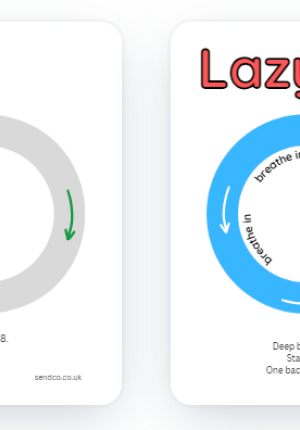
- “Lazy 8” tracing
- Cross-over clapping games
- Twist-and-reach sorting